






Autism In The Spotlight
The cause of Autism continues to be in the spotlight, or at least, in the center of great debate. Many still feel that autism is caused by the mercury based preservatives used in vaccines. Numerous studies have and are, still dispelling this theory, or link because Thimerosol, was removed from vaccines in 2001. Even, still many parents are convinced otherwise, and are choosing to not vaccinate their children, in hopes of avoiding autism.
Many experts feel that autism may be caused by a wide range of many factors, including genetics and the environment. Today, there is still NO known cause, and it is still a mystery as to what factors are key in the onset of the disorder. Scientist’s are still saying there is no link found between Autism and vaccines.
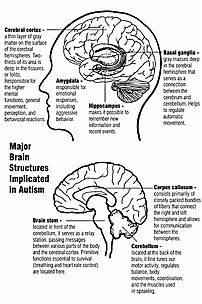
- Image via Wikipedia

As I have said before, environmental factors should and must be considered, as there is no such thing as a genetic epidemic. Still, I’m left to recall in my day, there were perhaps three shots we were required to have. Polio, Tb, and smallpox. Now, there are over thirty shots a child is subjected to by the time they reach age 5. Leaves me to think something is not right somewhere in this picture. No small wonder that some parents who have children affected by ASD (Autism Spectrum Disorder), feel that there is a conspiracy going on.
Here is what we know about Autism.
The odds of autism are 1 in every 150 children in the United States. In the U.K. the odds are 1:88, or one in every 54 boys. Another unknown, is that boys are 4 times more likely to be affected by the disorder than girls. Yet girls, are often times more profoundly affected.
Often typically appearing before the age of 3, Autism is a lifelong non-progressive disorder.
Signs and symptoms include, language and communication deficits, including withdrawal from social contacts, lack of making eye contact, and extreme reactions to their immediate environment.
It costs approximately $3.2 million to take care of an autistic person over their lifetime. Indirect costs for autistic individuals and their parents can range from $39,000 to $130,000 annually. Let’s not forget that there are still many who are institutionalized.
The divorce rate of parents with autistic children is at 80%. Sibling in the environment are under tremendous pressure to help care for their affected sibling on the spectrum.
There is cause to be encouraged, as far as cost factors involved in treating autism. As of Friday, January 30, 2009, Democratic leaders of the House and Senate have pledged to provide expanded insurance coverage to families to help pay for the expense of diagnosis and treatment of people with autism. There is a nationwide effort that has been proposed similar Legislation in 30 states , including Connecticut. It is a much needed and helpful thing for all families dealing with ASD.

![Reblog this post [with Zemanta]](http://img.zemanta.com/reblog_e.png?x-id=9b063450-c5fb-43c4-a3d7-ca5d489acbb2)