

Goal For The Green

Para-education and green living information

Autism In The Spotlight

Jan-31-2009 By Barbara Zak

The cause of Autism continues to be in the spotlight, or at least, in the center of great debate. Many still feel that autism is caused by the mercury based preservatives used in vaccines. Numerous studies have and are, still dispelling this theory, or link because Thimerosol, was removed from vaccines in 2001.  Even, still many parents are convinced otherwise, and are choosing to not vaccinate their children, in hopes of avoiding autism.

Many experts feel that autism may be caused by a wide range of many factors, including genetics and the environment.  Today, there is still NO known cause, and it is still a mystery as to what factors are key in the onset of the disorder.  Scientist’s are still saying there is no link found between Autism and vaccines.
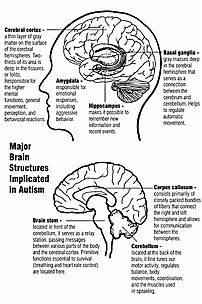
Major brain structures implicated in autism.
Image via Wikipedia

As I have said before, environmental factors should and must be considered, as there is no such thing as a genetic epidemic.  Still, I’m left to recall in my day, there were perhaps three shots we were required to have.  Polio, Tb, and smallpox.  Now, there are over thirty shots a child is subjected to by the time they reach age 5.  Leaves me to think something is not right somewhere in this picture.  No  small wonder that some parents who have children affected by ASD (Autism Spectrum Disorder), feel that there is a conspiracy going on.

Here is what we know about Autism.

The odds of autism are 1 in every 150 children in the United States.  In the U.K. the odds are 1:88, or one in every 54 boys.  Another unknown, is that boys are 4 times more likely to be affected by the disorder than girls.  Yet girls, are often times more profoundly affected.

Often typically appearing before the age of 3, Autism is a lifelong non-progressive disorder.

Signs and symptoms include, language and communication deficits, including withdrawal from social contacts, lack of making eye contact, and extreme reactions to their immediate environment.

It costs approximately $3.2 million to take care of an autistic person over their lifetime.  Indirect costs for autistic individuals and their parents can range from $39,000 to $130,000 annually.  Let’s not forget that there are still many who are institutionalized.

The divorce rate of parents with autistic children is at 80%.  Sibling in the environment are under tremendous pressure to help care for their affected sibling on the spectrum.

There is cause to be encouraged, as far as cost factors involved in treating autism.  As of Friday, January 30, 2009, Democratic leaders of the House and Senate have pledged to provide expanded insurance coverage to families to help pay for the expense of diagnosis and treatment of people with autism. There is a nationwide effort that has been proposed similar Legislation in 30 states , including Connecticut. It is a much needed and helpful thing for all families dealing with ASD.

Adgitize your web site.

Reblog this post [with Zemanta]

Question- To Vaccinate Or Not?

Nov-29-2008 By Barbara Zak

With the odds of autism being 1:150 here in the US, it cannot compare to the now epidemic proportions of the disorder currently found in the UK.  The rate of autism in the UK is now 1:88 or I in every 54 boys. The belief that autism is solely genetic is unverifiable.  Environmental factors must be considered because, after all, there is no such thing as a genetic epidemic.

Recently,I did an update on autism in the news. The topic of vaccinating as a cause was explored. To anyone who has a child with autism, you may never fully convince them that childhood vaccines had nothing to do with their child’s autism. On the contrary,

Autism fears lead some parents to not immunize children

The CDC (Center For Disease Control and Prevention) stands by their claim that scientist say there is substantial evidence that there is no link. Yet, around the country, there is debate over what role, if any, vaccinations play in autism, and many parents are deciding against immunizations. Most feel that they would rather risk their child getting measles, chicken pox or the flu, than autism.

David Kirby writes in The Huffington Post regarding a new study about “mitochondrial autism” that it is real, and that vaccine triggers cannot be ruled out. This article is a must read for the latest information on this pivotal topic.

Another must read to bring you up to date on this issue is Ginger Taylor’s “Adventures in Autism”. While at Ginger’s blog you may also want to consider reading about how the FDA hid the names of contaminated infant formula products from the public, in the most recent case of melamine contamination.

Special thanks to Google news for these excellent sources of current information on Autism in the news.

Adgitize your web site.

It Happens Every 18 Minutes !

Aug-6-2008 By Barbara Zak

In the United States, there is a baby born every 18 minutes that will acquire autism.  In most cases it makes itself known before the age of three. The statistics are alarming, and the increase in diagnosed cases has risen dramatically in the last twenty years. Still scientists don’t know exactly what causes the mysterious developmental brain disorder, and there is no cure. It is believed that both genetic and environmental factors could be to blame.

In a recent study, John’s Hopkins University neurologist, Harvey Springer, wondered if mother’s of autistic children might produce immune protein (antibodies) that react with or possibly harm their baby’s brains during pregnancy.

Other studies have linked autism to the immune system, in particular to auto immune reactions. In some cases of auto immune reactions, the body’s own defenses mistakenly attack native tissue. It is known that Autistic people are more likely to make antibodies against their own brain cells. Auto immune disorders such as type 1 diabetes, are also more common in mothers of autistic children.

In his most recent study Dr. Springer and his team, collected blood samples from 200 participants. There were 100 mothers of children with moderate to severe autism, as well as 100 mothers of healthy children. They only extracted antibodies that could cross the placenta during pregnancy. Then they tested those antibodies against the proteins from human fetal brain tissue. They discovered that the blood from the mothers of autistic children reacted to at least two fetal brain proteins. However, all the mothers tested had similar reactions to each other, against other proteins that were tested.

It is Dr. Singer’s hope that “These immune factors may help trigger or turn on some underlying or potential problem.” It is not yet known the role that brain proteins play during development, nor is it known whether the maternal antibodies in any way influence their function. Dr. Singer’s team will be investigating these questions (in his ongoing study) by injecting pregnant mice with human maternal antibodies to determine if their offspring show any developmental problems.