

Goal For The Green

Para-education and green living information

A Look at Our Energy Consumption

Jan-3-2012 By Barbara Zak

A Look at Our Energy Consumption

A look at our energy consumption, is probably the furthest thing from your mind, as you are putting away all those Christmas lights. Don’t you sometimes feel like you might actually get ahead of the game, if you weren’t paying so much for your electric bill?  Thanks, to this new infographic chart from Credit Sesame, you can now get a better idea of where all that money goes, and how your energy dollars are used. It takes a look at our energy consumption.
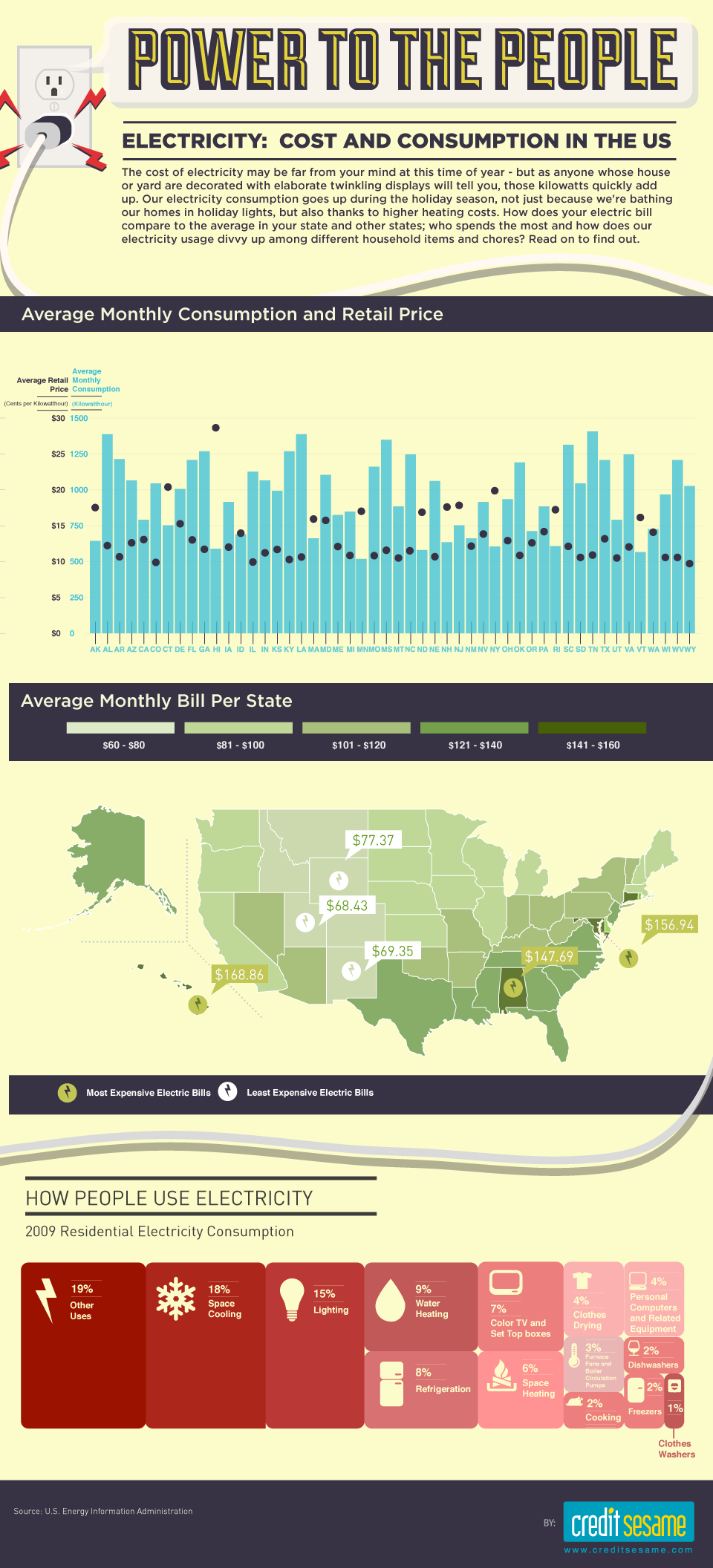
So, I wanted to pass along this informative infographic from Credit Sesame: Power to the People. Click on the link for the full size version of the chart.  The graphic chart takes a look at electricity cost and consumption across the U.S.

Right now, our electric costs may be the last thing on our minds, as we are putting away our holiday chores and preparations for the end of 2012. But, if you’re like most of us Americans, chances are you’ll get a bit of a shock in the mail when that next bill arrives.

A Look at Our Energy Consumption and How We Consume Energy

This chart, is a look at how we consume energy. It’s not just because of those festive holiday lights, all around your house and yard, that are driving up the cost. It’s everything else we tend to do more of during the winter. Especially, during the holidays, there is more cooking, washing and drying, heating the home, and cranking up the heat on those chilly nights. Even watching TV, or using other electronics, seems to cost more this time of year, perhaps, because we spend more time indoors. We want our homes warm and cozy.

Here in Washington, it seems crazy what we pay for electricity, when we have an abundance of hydro-electric power. Perhaps, we shouldn’t complain much, because other places in the world, are doing without our creature comforts, or they are paying even more, than we are.

A Look at Our Energy Consumption and Your Questions

So, just a few questions for you to ponder and check out on the chart here, about our energy consumption and how we consume energy.

How does your typical monthly electric bill compare to the average in your state? How about the rest of the United States? Where exactly do those kilowatts go?  Where is electricity the cheapest? Check out this handy chart for some eye opening information.  I hope you have found this information useful, and you are welcome to share your thoughts, here.  In more ways than one, here’s hoping 2012 brings Power to the People, as we take a look at our energy consumption!

Enhanced by Zemanta

Liters of Light

Dec-12-2011 By Barbara Zak

This post is written in association with MSM Energy/Plastic Bottles

Philippino homes are given one million Liters of Light

If you had the choice between a light bulb you’d have to compare electricity prices and pay for, and one that came with no electricity bill, no batteries or, in fact, no consumable energy source whatsoever, and it would have a shelf life of years, not months, which would would you choose?

The founder of My Shelter Foundation, Illac Diaz, has announced an initiative he’s named ‘A Liter of Light’ (otherwise known as Isang Litrong Liwanag in Philippino), with big plans afoot, for millions of Philippino homes to be given one million liters of light.  Here is an example of how his Liters of Light plan works.

Philippino lives are transformed by Liters of Light from two liter soda bottles

First developed by students at the Massachusetts Institute of Technology, the two liter bulb, made from soda bottles, caught Diaz’s attention, when he recognized that it had the potential to instantly transform the lives of millions of impoverished Filipinos, who are living without an electricity supply and in virtually constant darkness.

Invention


A Brazilian mechanic and inventor called Alfredo Moser, has been hailed as the energyless light bulb creator. It’s said that he came up with the idea, when he wanted to find a way of saving on his own energy bill, back in 2002.

Phillipino homes are seeing Liters of Light from water filled two liter bottles

Moser, decided to cut holes in the roof of his workshop.  Then he set Read the rest of this entry »

We all know that America needs to become energy independent.  However, there isn’t a clear vision for achieving that goal, and no real clear cut plan either.  Here are ten steps we could make toward achieving energy freedom.

1.  There are 10 foreign government run oil companies that are much larger and have greater oil reserves than our Exxon Mobil. So, we need to quit blaming “big oil” here at home.  Even if they did make a record profit of $12 billion in less than 90 days.

2.  Congress and lawmakers should address or own domestic supply and production problems. If they increased our supply from our own sources and reserves, it could have an impact on the price we pay at the pump.

3.  We can make a difference by turning off lights at home, when not in use.  We can also save gas instead of time by slowing down our driving speed.  We can also save energy by keeping our thermostats set at 68 in the winter and 75 in the summer.

4.  Remember when grandma use to hang clothes out on the line and how nice and fresh they smelled? Or how about installing rain barrels to water the lawn instead of pumping water from the well.  If you aren’t on a well system, you can conserve water by using drip or soaker hoses.

5.  There must be a determination in this country to develop alternative energy sources such as solar, wind, biomass, and geothermal technology.  There is is no room for the NIMBY (not in my backyard) attitude.  This only slows progress that needs to happen.

6.  We need to build and reopen nuclear plants.  France gets 77% of its energy from nuclear sources.  We need to follow what they have learned in regard to safe usage of nuclear power and the recycling of nuclear waste.

7.  We should increase hydroelectric power in states where it is plentiful.  There should also be an environmental push to increase the survival rate of young salmon migrating to the Pacific regions

8.  If we develop and deploy our environmental cleanup strategies to developing economic powers such as China India and others, they could generate electricity from their abundant coal reserves.  This would drastically reduce air and water pollution in those countries, and make their people healthier.  Taking this step would also provide new markets for our American companies and create new jobs.

9  We need to produce more of our own oil and natural gas, while other technology and alternatives are being developed.  There is enough domestic natural gas offshore to supply the United States for the next 10 years easily.  The production technology is much safer than it was 30 plus years ago.  There are 109 offshore oil platforms in the Gulf of Mexico that were directly hit during Hurricane Katrina without causing a significant spill.

10.  It will take patience and common since, as well as time and money to transform new technology and find new sources of energy.  The solutions won’t happen overnight, however, we need a dedicated government to get behind these issues and make sure these changes happen in a timely fashion.