

-
Sep19
Where Do Ladybugs Live?
Filed under: Featured, Nature, green living, ladybugs; Tagged as: antennae, aphids, black image, black legs, english speaking countries, fence row, ground cover, hiding places, lady beetles, ladybirds, ladybug, ladybugs, larva stage, pale yellow eggs, plant leaves, preferred term, tree stumps, types of vegetation, wikipedia, winter cold24 CommentsLadybugs, also known by their scientific name of Coccinellidae, are a member of the family of beetles. They are also known as ladybirds in (British English, Australian English, and South African English speaking countries), and ladybugs is the preferred term in North America. Some scientist refer to them as lady beetles.
Ladybugs (Coccinellids) are found worldwide, in almost any type of climate, and in wetlands. However, they won’t fly if the temperature is below 55 degrees fahrenheit. There are over 5,000 species described, with more than 450 species that are native to North America alone. They are small insects, ranging from 1 mm to 10 mm (0.04 to 0.4 inches), and are usually yellow, orange, or scarlet with small black spots on their wings, with six black legs, their head and antennae are also usually black.
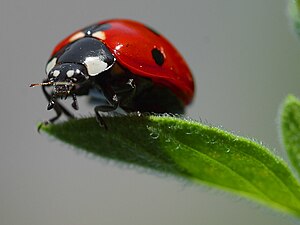
- Image via Wikipedia
In the spring, the female ladybug lays her tiny, pale yellow eggs in clusters of ten to 50 on the underside of plant leaves, near colonies of aphids. Three to five days later the larvae hatch. They look much like miniature alligators, usually gray or black, with bright spots.
After hatching, the larva immediately start killing and eating aphids. A single ladybug consumes about 5,000 aphids in his or her lifetime: 400 aphids are consumed, just in the larva stage. Two to three weeks later, the larva pupates on a leaf, and transforms to an adult. Then as an adult, consumes another 4600 aphids in their lifetime.
During the summer, ladybugs live in shrubs, branches, and flowers, in fields, gardens, and on plants . During autumn , they form a colony called coleptera. Then, they find and crawl to protective hiding places, such as tree stumps, cracks in wood, or in ground cover types of vegetation. This then becomes a place to hibernate–at the base of a tree, along a fence row, under a fallen tree, or even under a rock. They crawl under leaves to protect themselves from the winter cold. The fascinating thing is, they can hibernate in groups of 50 to 100 million, to produce and conserve warmth. Most ladybugs only live for several months, but some can survive longer.
Generally, ladybugs are considered useful insects, as many species feed on aphids or scale insects, which are pests in gardens, agricultural fields, orchards, and similar places. There fore, they have been termed as a ” gardeners best friend”. Some people consider seeing them or having them land on their body, to be a sign of “good luck”.
24 Responses to “Where Do Ladybugs Live?”
-
Thanks for the interesting article! I learned a thing or two. I had no idea ladybugs hibernated in the winter, sometimes in large groups.
Ann Martin´s last blog ..Book Signing October 17th at Legacy Books in Plano
-
Interesting information.
Dr.prahallad Panda´s last blog ..Foreignbody in Respiratory Tract & Accidental Entry.
-
@ Ann Martin,
Thank-You for stopping by and commenting. I’m glad you found the information of interest to you.
-
@ Dr. prahallad Panda,
Thanks for commenting!
-
I’ve always liked lady bugs. They’re the only bugs I’m not scared of!
cady´s last blog ..29 Weeks
-
У данной статьи четко выраженный информативный стиль, большое спасибо Вам!
-
@ cady,
I’m glad you’re not afraid of them. They really are useful little critters!
-
@ Irdana,
Translation form Bable Fish.
This article has the clearly expressed informative style, the many thanks to you!
Thanks to you as well. I’m glad you enjoyed the information!
-
And they are very cute

vein´s last undefined ..If you register your site for free at
-
Hi, I am visiting from Adgitize. I love lady bugs, thanks for sharing this info
-
@ vein,
Yes, I think so too!
-
@ Jordasche Bledsoe,
You are very welcome. Thanks for stopping by and commenting!
-
Hi,
Not sure that this is true:), but thanks for a post.
Thanks
Robor -
@ Robor,
You are welcome….and I don’t lie!
-
I love ladybugs and now I now why and I really enjoyed this post.
Dorothy from grammology
grammology.com
Dorothy Stahlnecker´s last blog ..Vacations can be exhausting
-
@ Dorothy Stahlnecker,
I’m glad you enjoyed the post ..and Thanks for stopping by to comment!
-
I love lady bugs. Interesting info!
corrin´s last blog ..Kitchen Scissors
-
@ corrin,
Thank-You!
-
Very interesting! I love the picture. Red is the color I think all lady bugs should be.
-
@ Karen,
Oh, I totally agree with you on that!
-
Блог отличный. Награду бы Вам за него или просто орден почета.
-
@ Vike,
Translation from BabelFish.
[Blog] is outstanding. The reward to you for it or it is simple the order of honor.
Thank-You for your kind words. It is an honor and a pleasure to be so well received. I’m glad you enjoyed your visit here!
-
I’ve always loved ladybugs since I was a child and that’s a long time. It was fun to learn more about them. Love the photo too.
ConnieFoggles´s last blog ..Cooking Lessons In Branson
-
@ ConnieFoggles,
I’m glad you had a fun learning experience. That’s what I love to hear, and what I hope, keeps you coming back to visit!

![Reblog this post [with Zemanta]](http://img.zemanta.com/reblog_e.png?x-id=b8fb2794-069a-4c3b-99f0-c57a8f508c79)


Recent Comments